
Oct.19, 2026
Share:
Why Hygienic Design Matters in Food Conveying Systems
In food processing, conveying equipment does more than move products from one stage to another. Its design can also affect food safety, cleaning efficiency, and the overall reliability of the production line.
A well-designed food conveying system helps reduce contamination risks, minimize material residue, and support consistent production. For food manufacturers, hygienic design should therefore be considered an important part of equipment selection—not an afterthought.
1. Reduce Contamination Risks During Conveying
Food products may pass through multiple stages, including processing, sorting, weighing, and packaging. If conveying equipment contains hard-to-reach areas where food residue accumulates, cleaning becomes more difficult and contamination risks may increase.
A hygienic food conveyor should be designed with suitable contact materials, accessible surfaces, and a structure that supports effective cleaning. For applications requiring corrosion resistance, stainless steel construction may be appropriate, depending on the product, cleaning chemicals, and operating environment.
These considerations are particularly important for conveying nuts, snacks, frozen foods, and other products that require controlled handling conditions.
2. Make Cleaning and Maintenance Easier
Frequent cleaning is part of daily food production. Equipment that is difficult to access or disassemble can increase downtime and make routine maintenance more complicated.
When selecting a belt conveyor or chain plate conveyor, manufacturers should consider belt or plate accessibility, frame structure, material residue, and the cleaning methods used in their facilities.
For example, an easy-to-clean inclined PU belt conveyor may be suitable for applications where convenient belt cleaning is a priority. A horizontal belt conveyor can also be configured to support product transfer between processing stages while taking cleaning access into account.
The right design depends on the food being conveyed and the plant's actual sanitation procedures.
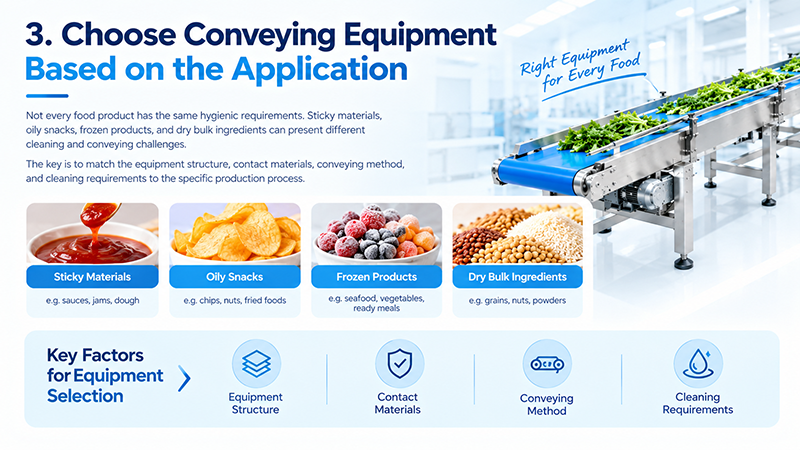
3. Choose Conveying Equipment Based on the Application
Not every food product has the same hygienic requirements. Sticky materials, oily snacks, frozen products, and dry bulk ingredients can present different cleaning and conveying challenges.
A Z type bucket elevator may be suitable for lifting nuts, seeds, and other bulk products to weighing or packaging equipment. A chain plate conveyor may be more appropriate for applications requiring stable product support, while a belt conveyor can provide smooth, continuous movement.
The key is to match the equipment structure, contact materials, conveying method, and cleaning requirements to the specific production process.
4. Integrate Hygienic Design into the Entire Production Line
Hygiene should not be considered only at the individual machine level. Transfer points between conveyors, elevators, processing equipment, and packaging machines also deserve attention.
A poorly planned connection may create residue buildup, make cleaning difficult, or interrupt product flow. Therefore, manufacturers should evaluate equipment layout, transfer height, connection points, and maintenance access when planning a complete conveying system.
With a customized conveying solution, equipment dimensions, conveying direction, lifting height, and connection positions can be adapted to the production line. This helps manufacturers balance hygienic requirements with production efficiency and available factory space.
Final Thoughts
Hygienic design plays an important role in food conveying because it affects cleaning, contamination control, maintenance, and production continuity.
Before selecting a food conveying system, consider the product characteristics, cleaning procedures, equipment materials, and connections between production stages. Choosing suitable equipment and planning the complete conveying process together can help build a more practical and reliable food production line.
Visou provides conveying and lifting equipment that can be configured for different material handling requirements. Manufacturers can evaluate individual equipment options or explore customized conveying solutions based on their product characteristics and production layout.