
Sep.15, 2026
Share:
How to Choose the Right Food Conveyor System for Your Production Line
Choosing the right food conveyor system is an important decision for any food processing or packaging line. A suitable conveyor can improve product flow, reduce manual handling, protect product quality, and make the entire production process more efficient.
However, there is no single conveyor solution that fits every food production line. Different products, production capacities, factory layouts, hygiene requirements, and transfer heights require different conveyor designs.
So, how do you choose the right food conveyor system for your production line?
This guide explains the key factors you should consider before selecting a food conveyor system.
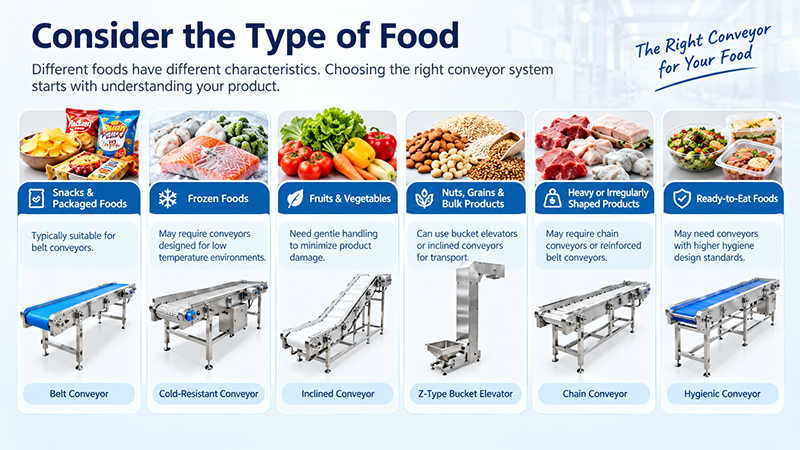
1.Consider the Type of Food Product
The first step is to understand the characteristics of the product being transported.
Food products can vary significantly in size, shape, weight, moisture content, temperature, and fragility. These characteristics directly affect the type of conveyor that should be used.
For example:
● Snacks and packaged foods may be suitable for belt conveyors.
● Frozen foods may require conveyors designed for low-temperature environments.
● Fruits and vegetables may need gentle conveying to minimize product damage.
● Nuts, grains, and other bulk products can be transported using bucket elevators or inclined conveyors.
● Heavy or irregular products may require a chain conveyor or a reinforced belt conveyor.
● Ready-to-eat foods may require a conveyor with a higher level of hygienic design.
Before choosing a conveyor, consider whether the product is loose, bulk, individually packaged, or packed in cartons.
2. Determine the Required Conveyor Capacity
Production capacity is another important factor.
A conveyor system should be able to handle the required product throughput without creating bottlenecks in the production line.
When selecting a conveyor, consider:
● Required throughput per hour
● Product weight
● Product dimensions
● Conveyor speed
● Product spacing
● Loading method
● Required accumulation capacity
For high-speed food processing and packaging lines, the conveyor speed and product spacing need to match the upstream and downstream equipment.
For example, if a packaging machine operates at a high speed but the feeding conveyor cannot deliver products consistently, the conveyor may become a bottleneck.
A properly designed food conveyor system should provide stable and continuous product flow throughout the production process.
3. Check the Factory Layout and Transfer Height
Factory space is often limited, especially when an existing production line needs to be upgraded.
The available floor space, ceiling height, equipment arrangement, and transfer distance should therefore be considered before choosing a conveyor.
Horizontal belt conveyors are commonly used when products need to move over a relatively short or medium horizontal distance.
When products need to be transferred between different production levels, an inclined conveyor or bucket elevator may be more suitable.
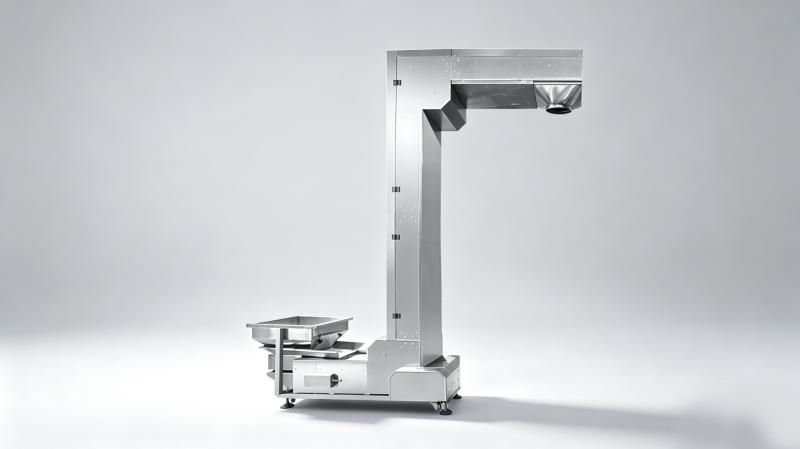
For example, a Z-type bucket elevator can lift bulk food products from a lower level to a higher processing or packaging station while making efficient use of vertical space.
This can help reduce the need for long horizontal conveyors and make better use of the available factory area.
4. Choose the Right Conveyor Type
Different food conveyor systems are designed for different applications.
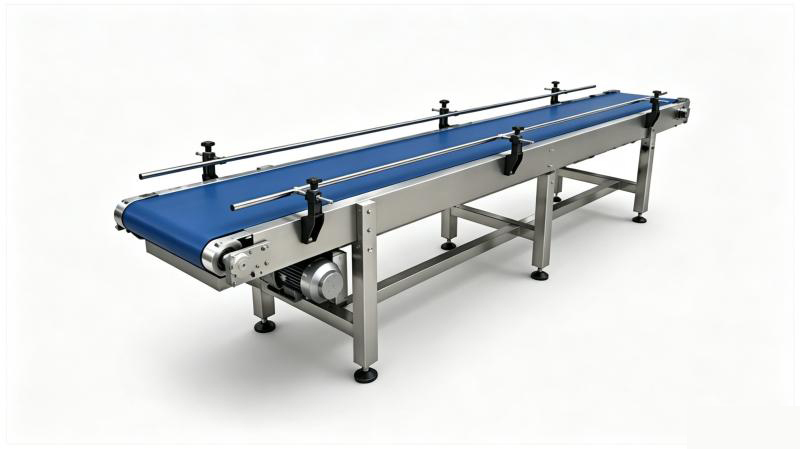
Belt conveyors are one of the most widely used solutions in food processing and packaging.
They can be used for:
● Packaged food
● Snacks
● Bakery products
● Fruits and vegetables
● Frozen products
● Boxes and containers
A horizontal belt conveyor is particularly useful when products need to be transported smoothly between processing, inspection, and packaging equipment.
Inclined Conveyor
Inclined conveyors are suitable when products need to be moved from a lower position to a higher position.
They can help connect equipment installed at different heights while reducing the amount of floor space required.
For food production lines, hygienic PU belt conveyors and other easy-to-clean designs can be considered depending on the product and sanitation requirements.
For bulk products, a Z-type bucket elevator can provide an efficient solution for vertical or multi-level conveying.
It is commonly considered for products such as:
● Nuts
● Seeds
● Snacks
● Candy
● Cereals
● Frozen food
● Granules
● Other free-flowing food products
The bucket design allows products to be lifted with controlled movement and discharged at the required height.
Chain plate conveyors are another option for food production and packaging lines.
They can be used when products require stable conveying, precise positioning, or a more rigid conveying surface.
Depending on the application, chain plate conveyors can be designed for horizontal or inclined conveying.
5. Pay Attention to Food Hygiene
Hygiene is one of the most important considerations when selecting a food conveyor.
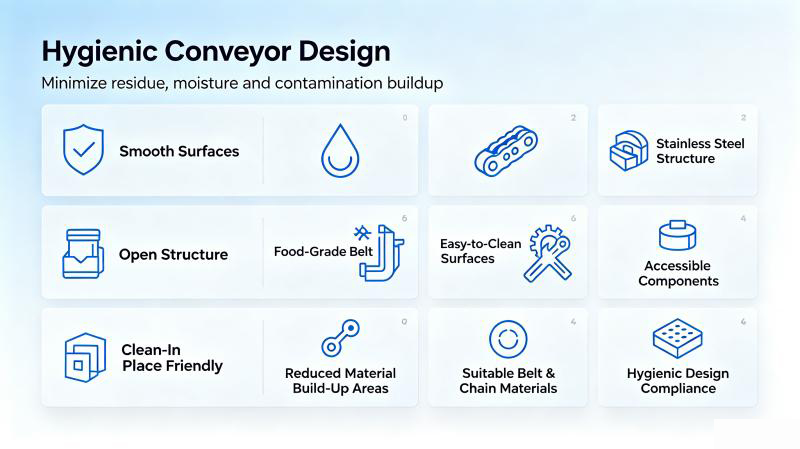
A conveyor used in food production should be designed to facilitate cleaning and reduce areas where food residues, moisture, or contaminants can accumulate.
Depending on the application, you may want to consider:
● Stainless steel construction
● Food-grade conveyor belts
● Easy-to-clean surfaces
● Accessible conveyor components
● Reduced product accumulation areas
● Suitable belt and chain materials
● Hygienic structural design
For wet or high-humidity processing environments, corrosion resistance and cleaning requirements become even more important.
The conveyor should also be selected according to the specific sanitation procedures and food safety requirements of the production facility.
Creating More Efficient Food Production Lines
Selecting the right food conveyor system involves far more than simply moving products from point A to point B.
An ideal conveyor system ensures smooth product transport, complies with food hygiene standards, safeguards product quality, fits within the existing facility layout, and operates seamlessly alongside other production equipment.
Whether the choice is a horizontal belt conveyor, an inclined conveyor, a slat conveyor, or a Z-type bucket elevator, the specific selection should be based on the actual requirements of the production line.
If you are planning a new food processing or packaging line—or looking to upgrade an existing conveyor system—please provide us with details such as product specifications, capacity requirements, equipment dimensions, and layout plans. We can then tailor a solution specifically to your operational needs.