
Oct.14, 2026
Share:
Belt vs. Chain Conveyor: Which Is Better for Food Production?
Choosing the right conveyor can make a significant difference to material flow, production efficiency, and line layout in a food processing facility. Among the most commonly used solutions, belt conveyors and chain conveyors are often considered for the same production line—but they are designed for different conveying needs.
So, which one is better for food production?
The answer depends less on the conveyor itself and more on what you need to convey, how the material moves, and how the conveyor connects with the rest of the production line.
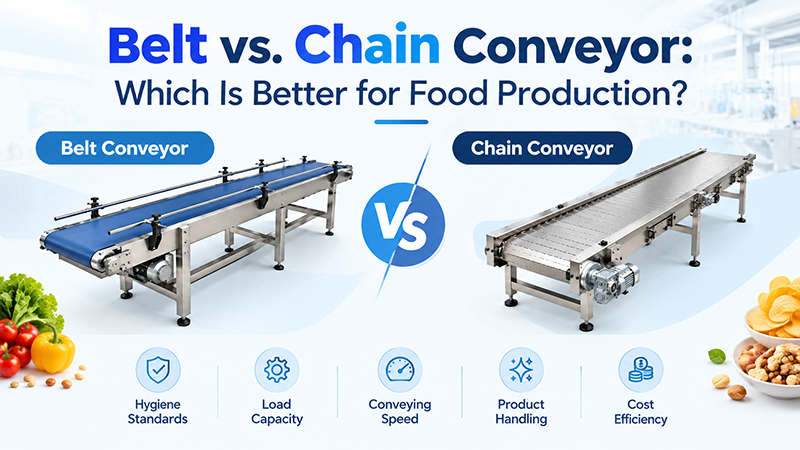
Belt Conveyor: A Flexible Solution for Continuous Conveying
A belt conveyor is widely used for transporting packaged food, snacks, vegetables, frozen products, and other materials that require smooth and continuous movement.
The continuous belt surface provides stable product support, making it suitable for applications where products need to move smoothly between processing, inspection, sorting, and packaging equipment.
A food belt conveyor can also be designed in different lengths, widths, and configurations according to the production line layout.
It is often a practical choice when:
● Products require smooth and stable conveying
● Materials are relatively lightweight
● Continuous horizontal or inclined conveying is required
● Products need to move between different processing stages
● Flexible layout and easy integration are important
For example, a horizontal belt conveyor can transfer products between processing equipment, while an inclined belt conveyor can help move materials to a higher position.
Chain Conveyor: When Load and Stability Matter More
A chain conveyor uses a chain-driven conveying surface instead of a conventional belt. This structure makes it suitable for applications where products are heavier, larger, or require stronger conveying support.
In food production, chain conveyors and chain plate conveyors are commonly considered for products that need stable transportation or for production lines where the conveyor must handle a relatively demanding working environment.
A chain plate conveyor can be a suitable option when:
● Products are relatively heavy or irregular
● Stable product positioning is important
● The conveying process involves frequent transfers
● A stronger conveying structure is required
● The production line requires reliable long-term operation
For some applications, a chain plate conveyor can also be combined with an inclined configuration to move products between different production levels.
| Requirement | Belt Conveyor |
|
| Lightweight products | Excellent | Suitable |
| Smooth product conveying | Excellent | Good |
| Heavy products | Moderate | Excellent |
| Irregular products | Good | Excellent |
| Continuous conveying | Excellent | Excellent |
| Flexible line layout | Excellent | Good |
| Strong conveying support | Good | Excellent |
For lightweight products, packaged foods, and applications requiring smooth movement, a belt conveyor may be the more practical solution.
For heavier or irregular products that require stronger support and stable transportation, a chain conveyor or chain plate conveyor may be more suitable.
The Best Conveyor Is the One That Fits the Entire Production Line
In real production environments, the decision should not be based on the conveyor alone.
Consider how materials enter the conveyor, where they need to go next, whether the conveying height changes, and how the conveyor connects with weighing, inspection, processing, or packaging equipment.
For example, a production line may use a horizontal belt conveyor for product transfer, a Z type bucket elevator for vertical material lifting, and a chain plate conveyor for stable transportation through another processing stage.
The goal is not simply to choose a belt or a chain. It is to create a continuous and reliable material conveying system that matches the entire production process.
Final Thoughts
Belt conveyors and chain conveyors each have their strengths. The right solution depends on product characteristics, conveying distance, load, production speed, and the connection between different processing stages.
Before choosing equipment, look at the complete material flow rather than a single conveyor section. A well-matched conveying system can help reduce unnecessary transfers, improve material movement, and make the overall production line more efficient.