
Application
Fresh Food Cold Chain (Meat, Poultry, Seafood, Cleaned Vegetables, Frozen Prepared Foods)
The core technical challenges facing fresh food cold chain conveyor lines lie in extreme physical environments (low temperature, high humidity, specific corrosion) and stringent requirements for food safety and hygiene compliance (FDA/European standards).

Frozen Food

Meat, poultry and seafood

Vegetable
The core technical challenges facing fresh food cold chain conveyor lines lie in extreme physical environments (low temperature, high humidity, specific corrosion) and stringent requirements for food safety and hygiene compliance (FDA/European standards).
Extreme Low Temperature Environments (Causing Component Brittleness and Cracking, Transmission Stickiness and Seizure)
Cause of Pain:
Under cryogenic or rapid freezing conditions, conventional plastics, rubbers, and seals are prone to hardening and cracking; the viscosity of lubricating grease in the transmission system increases dramatically at room temperature, leading to motor overload or even equipment seizure.
Engineering Solution:
High Cold-Resistant Materials Science: Customized modified ultra-high molecular weight polyethylene (UHMW-PE) and specific cold-resistant elastomers are used throughout the entire line to ensure that chains and belts retain extremely high toughness at low temperatures.
Cryogenic-Specific Transmission Grease: Professional-grade low-temperature, food-grade lubricating grease is used throughout the transmission and bearing systems, ensuring stable operation over a wide temperature range and preventing oil film solidification due to sudden temperature drops.
High Humidity Condensation Corrosion (Causing Mold Growth, Rusting and Failure of Ordinary Metals)
Cause of Pain:
Alternating hot and cold temperatures cause intense condensation in the air. The frequently generated condensate not only easily breeds bacteria and mold but also causes continuous oxidation and corrosion to the metal structure of the production line.
Engineering Solution:
Stainless Steel Hygiene-Grade Manufacturing: The entire machine structure is constructed using high-grade food-grade stainless steel (SUS304 / SUS316L), possessing excellent resistance to chloride ions and acid/alkali corrosion.
Fully Welded Seamless Process: The entire line is fully welded and finely polished (mirror finish/polish), fundamentally preventing moisture penetration and eliminating pitting corrosion sources, ensuring overall compliance of the workshop.
Hygiene Cleaning Dead Zones (Leading to Foam Retention, Hardening, and Risk of Excessive Bacteria)
Cause of Problem:
Minced meat, scum, and grease from fresh food processing easily accumulate in tiny gaps, rapidly hardening at low temperatures, making them difficult to completely remove using conventional cleaning methods.
Engineering Solution:
Open-Type Rounded Geometry: Abandoning traditional seam structures, all material contact surfaces and steering joints utilize a large-radius rounded design, ensuring 100% visibility and water flow, eliminating cleaning blind spots.
High-pressure water washing: The entire drive motor, precision sensors, and electrical connectors have been upgraded to IP69K extreme protection level, capable of directly withstanding high temperatures, high-pressure water jets, and direct rinsing with powerful disinfectants.
Production equipment
CASE
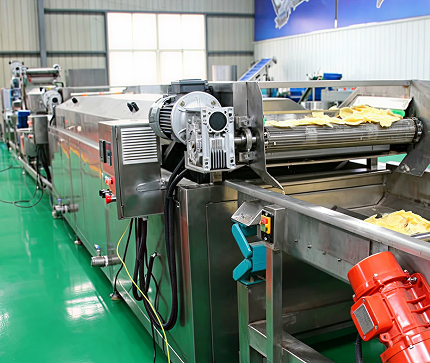
Complete Potato Chip Processing Solution
Intelligent conveying and performance reconfiguration solution for the entire potato chip production line
Read More
Complete Potato Chip Processing Solution
Intelligent conveying and performance reconfiguration solution for the entire potato chip production line
Read More
Complete Potato Chip Processing Solution
Intelligent conveying and performance reconfiguration solution for the entire potato chip production line
Read MoreFAQ
Q: What makes Visou different from traditional conveyor equipment manufacturers?
A:
Visou is not only a manufacturer of equipment, but also an expert in material handling solutions. We don't offer simple standard products, but rather deep customization based on the physical properties of the materials. We strive to solve problems such as material jamming, sticking, and breakage through targeted structural design, achieving stable production line operation.
Q: How can I customize my conveyor solution?
A:
We provide not only hardware, but also production engineering logic. Before confirming an order for production, we will fully understand your production needs, process flow, and on-site conditions. Combining your actual production situation, environmental factors, and factory space layout, we will conduct deep customization design to ensure that each solution is perfectly adapted to your factory production environment.
Q: What is the solution process and delivery cycle?
A:
The process includes: communicating requirements → clarifying processes and operating conditions → solution design and confirmation → deep customization manufacturing → in-plant online testing → delivery and commissioning. We implement a dual-track production model of "standard products + customized products". Standard components are mass-produced in a modular fashion to ensure timely delivery. For complex customized solutions, we use scientific scheduling to lock in the most reasonable delivery cycle while ensuring strict adherence to process requirements.
Q: How do you guarantee the quality and stability of the equipment?
A:
Material Selection and Process: We solemnly promise that the thickness and material selection of all structural components strictly adhere to the contract stipulations, never cutting corners, and strictly following national and European standards in design and production.
Engineering Quality: Visou has cultivated deep expertise for many years, and its core technical team inherits the accumulation of a senior engineering system. Through rigorous process control and factory testing, we ensure that every piece of equipment can operate stably under complex working conditions.
Q: How is equipment installation and commissioning carried out?
A:
Visou provides a one-stop closed-loop service from design and manufacturing to installation and commissioning. Our professional engineering team considers the difficulty of installation and commissioning from the initial design stage, aiming to make it as simple and convenient as possible. We not only guide the installation of the equipment but also conduct detailed commissioning tailored to your actual production line. We ensure that the equipment is delivered in optimal operating condition, seamlessly integrating with your existing production system and eliminating operational instability caused by improper installation.
Q: What is the equipment's troubleshooting mechanism?
A:
We have established a rapid emergency response mechanism to address the time-sensitive nature of industrial production. The extensive use of modular design in the product structure significantly reduces the difficulty of daily maintenance and repair. In the event of any abnormalities, we promise to intervene immediately, providing professional remote technical support to minimize downtime and ensure the efficient operation of your production line.